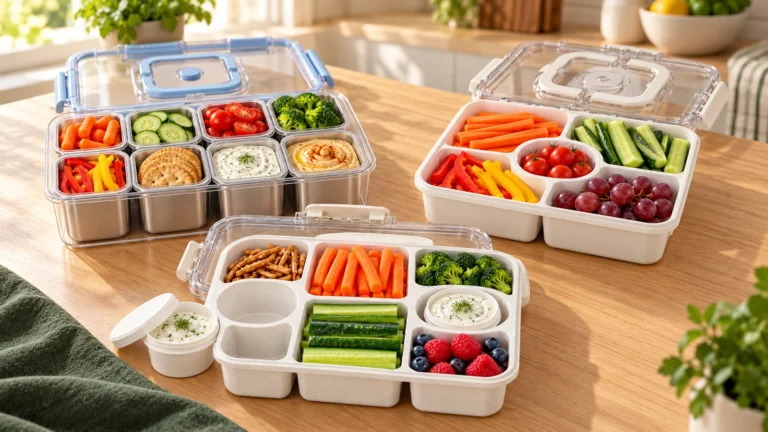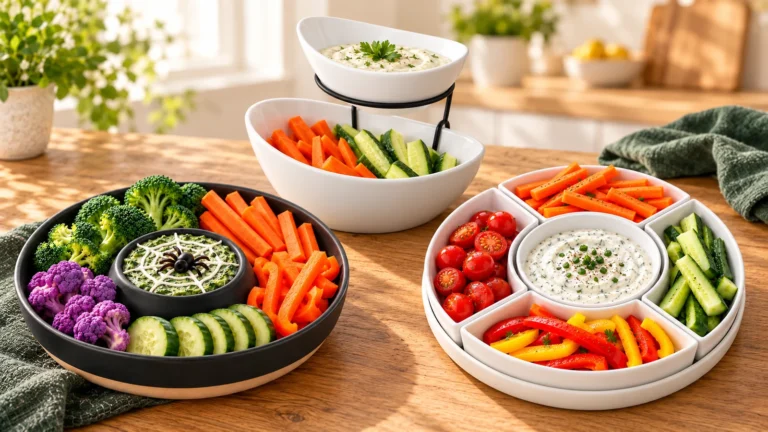
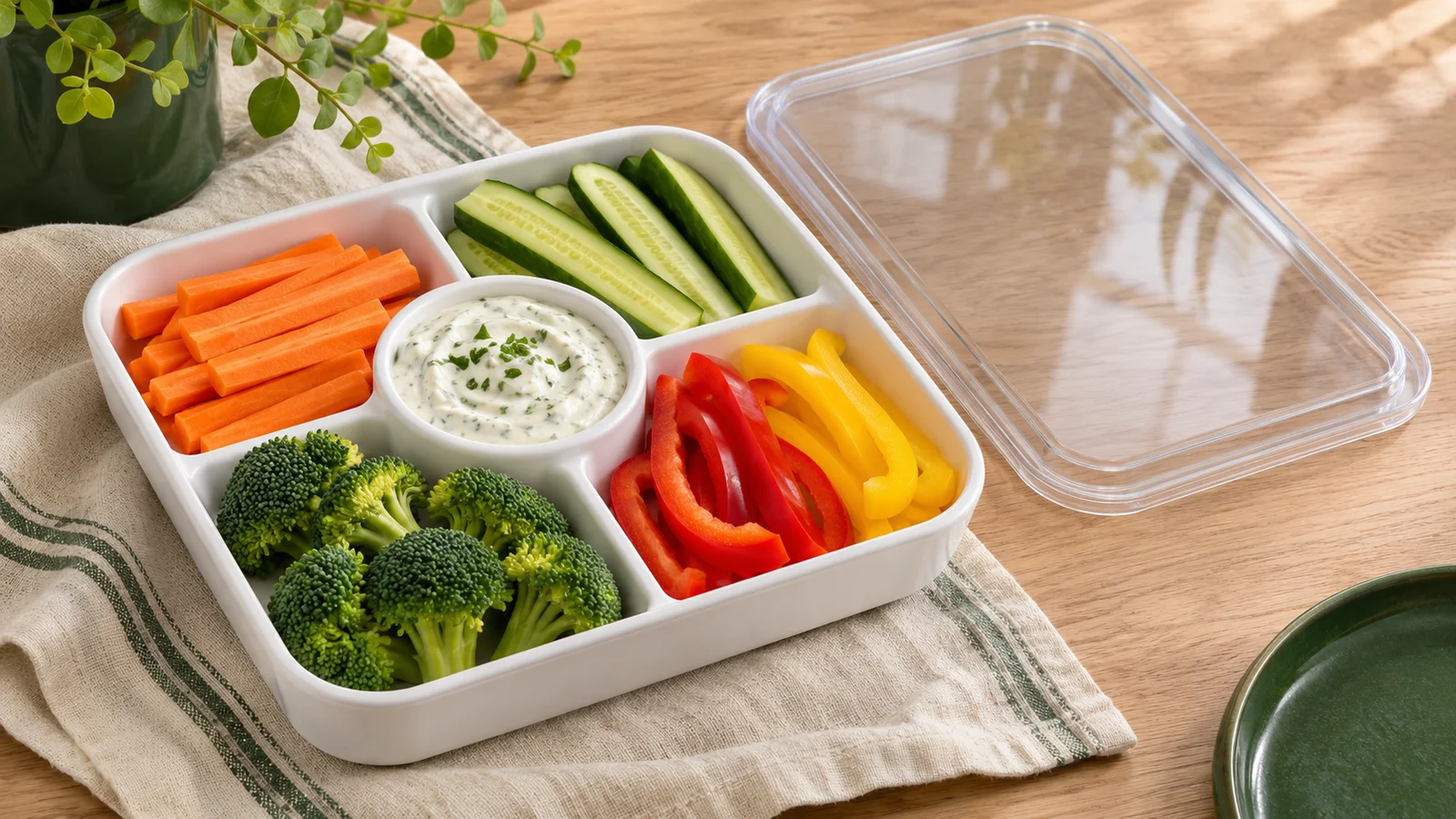
A veggie tray with lid can make it easier to prepare vegetables ahead, cover them in the refrigerator and carry them to a gathering. The useful features depend on the job: a low cover may suit refrigerator storage, while a deeper lid may leave room for a dip bowl and taller vegetable pieces.
Before buying, check three things: the usable space under the closed lid, how the dip is contained, and whether the complete tray fits in your refrigerator and cooler. A lid protects the arrangement, but it does not automatically make a tray leakproof or keep the food cold.
This guide focuses on choosing a covered serving tray for a shared vegetable platter. For smaller portions organized as individual snacks, a divided snack container may be more convenient.
Two Covered Veggie Trays to Consider
Affiliate disclosure: As an Amazon Associate I earn from qualifying purchases. If you buy through the Amazon links below, we may earn a commission at no extra cost to you. Read our affiliate disclosure.
These options offer different layouts: a larger rectangular tray and a round divided tray. We compared published product information; we have not tested these products. Confirm the selected variant, included parts and current seller details before ordering.
Buddeez Jumbo Divided Serving Tray with Lid
Consider this rectangular design when you want deeper sections for a shared party spread. Buddeez lists its Jumbo Party Tray with Cover, item 00188, at 15.75 × 11.25 × 3.81 inches. The center basin is shaped to accommodate a 16-oz dip container, and a separate snap-on cover is provided for the dip basin.
Why consider it: The rectangular footprint and separately covered dip basin suit a platter prepared for a gathering. Check first: Measure refrigerator and cooler space, confirm cleaning instructions for the exact item, and do not treat a snap-on cover as proof that every compartment is leakproof. See the manufacturer specifications.
View the Buddeez Jumbo Divided Serving Tray on Amazon.
SwivelServe Divided Serving Tray with Lid
Consider this round design when you prefer five outer sections around a center space for dip. The manufacturer describes a polypropylene tray with non-slip pads and a flexible lid, lists dishwasher-safe care and gives tray dimensions of 13 × 13 × 3 inches. The manufacturer describes the lid as airtight and leakproof; this is its claim, not a result of our testing, and it does not establish that the internal sections seal separately.
Why consider it: The round layout keeps vegetables grouped around the dip. Check first: Match the white tray-and-lid offer to its product details. A cutting board is included in some SwivelServe systems, but is not established as part of this Amazon offer. No separately lidded dip cup is established here. Consult the manufacturer’s tray specifications and verify the selected color and package contents.
View the white SwivelServe Divided Serving Tray with Lid on Amazon.
Other Covered Tray Designs for Comparison
These examples illustrate different layouts and lid arrangements. This is a research-based comparison of published product information, not a hands-on test or a ranked list. Product details were checked on November 5, 2026. Confirm the exact model, package contents and current availability before buying.
| Product | Documented design | Potential fit | What to check |
|---|---|---|---|
| Tupperware Serving Center Set | Six 2-cup sections; removable 14-oz dip bowl with its own seal; domed cover. Listed size: 13.5-inch diameter, 3.75-inch height. | A shared platter with a dedicated dip bowl. | The outer cover is not established here as leakproof. Confirm refrigerator fit and the exact US model. |
| Prodyne Flip-Lid Appetizers On Ice, SB-5 | Four-compartment tray; the cover inverts to hold ice beneath the serving tray. Listed size: 15 × 11.5 × 5 inches. | Serving over ice when the tray is open. | The same component serves as cover or ice tray; do not assume it does both simultaneously. No separately sealed dip cup is documented. |
| Rubbermaid Party Platter | Divided base, outer snap-on lid and removable Twist & Seal dip container, according to H-E-B. | A layout with separately contained dip for carrying. | Dimensions were not established from this source. Availability varies; the selected H-E-B store did not stock it. |
Tupperware: The manufacturer lists PP and PE materials and dishwasher-safe care. The tray and cover are not microwave-safe, and the set is not freezer-safe. Read the Serving Center product specifications for component-specific instructions. The cover can also be inverted for use with ice.
Prodyne: The manufacturer identifies BPA-free SAN polymer and built-in finger grips. Its site currently announces a pause in direct sales, so this is a design reference rather than a confirmed in-stock purchase recommendation. See the SB-5 manufacturer page. Cleaning instructions and any transport-sealing claim need confirmation.
Rubbermaid: H-E-B describes a leakproof inner dip container and a separate outer lid. That inner-container claim does not establish that every section of the platter is liquid-tight. See the retailer product description and verify the care label and dimensions of the item offered by your seller.
For a divided vegetable tray with a lid, start with the shape of your vegetables and the dip closure. If you need a large veggie tray with a lid, measure usable space rather than relying on a size label. A glass vegetable tray with a lid also needs verified weight, lid fit and handling instructions; no glass model is included in these examples.
For individual snack portions rather than a shared party platter, compare the approach in our snackle box container guide. For open serving bowls, see our chip and dip bowl guide.
Decide How You Will Use the Tray
| Main use | Features to prioritize | Detail to verify |
|---|---|---|
| Preparing vegetables before a party | Refrigerator fit, a useful cover and an easy-to-clean layout | External dimensions with the lid attached |
| Taking a platter to a potluck | Documented closure features, manageable size and secure dip storage | Carrying instructions and whether the lid is designed for transport |
| Serving several vegetables together | Usable sections, accessible dip placement and room for utensils | Internal layout rather than compartment count alone |
| Serving outdoors | Compatibility with your cooler or cold-holding arrangement | Space for cold sources; a lid is not refrigeration |
| Reusing the tray between parties | Flexible sections and practical cabinet storage | Whether inserts nest and how the lid is stored |
Choose for your most common use. An oversized carrier can be awkward to refrigerate, while a compact covered dish may suit regular snacks but require frequent refilling at a party.
Measure More Than the Diameter
Product listings often emphasize the width or diameter. For a covered tray, height matters just as much.
External Dimensions
Measure the space where you plan to store and transport the tray. Include clips, handles and the lid rather than comparing only the food-holding base.
Check the refrigerator shelf opening as well as its depth. A round tray may fit the shelf but be difficult to maneuver past containers already inside. If you plan to use a cooler, leave room for the cold-holding arrangement too.
Internal Space
Look for the dimensions of the actual food sections. Deep walls and a large center compartment can reduce the space available for vegetables even when the overall tray looks generous.
A useful planning exercise is to arrange a sample selection on a plate: carrots, cucumber, peppers and a dip bowl. Compare that footprint with the tray layout, leaving room to pick up the food.
Clearance Under the Lid
Check whether the lid can close over the dip bowl you intend to use. Its rim and cover may sit higher than the vegetables.
Avoid overfilling the tray to make it resemble a promotional photograph. The lid should close without pressing food into the seal, crushing vegetables or tipping the dip cup.
Choose the Compartments Around Your Vegetables
A divided serving tray can help separate carrot sticks, cucumber, celery and peppers. The shape of those sections matters more than having the highest number of them.
| Layout | Potential benefit | Possible limitation |
|---|---|---|
| Fixed sections around a center | A clear arrangement for vegetables and one dip | Small wedges may restrict longer cuts |
| Removable inserts | Different arrangements and separate access to each portion | More components to wash and store |
| Open platter with a separate bowl | Flexible spacing for several vegetables | Food may shift during transport |
| Multiple smaller dip sections | Room for more than one flavor | Less space for vegetables; sealing still needs verification |
If you regularly serve long celery sticks or cucumber spears, check their fit before choosing wedge-shaped sections. Shorter cuts can help, but should not be the only way to make an unsuitable tray usable.
For food selection and arrangement rather than container features, explore our creative veggie tray ideas.
Does the Dip Bowl Have Its Own Lid?
When choosing a veggie tray with lid, check whether the dip bowl closes separately. A cover over the entire platter does not necessarily seal the dip compartment.
For transport, look for a suitably closed dip container or a clear manufacturer statement about the dip compartment’s sealing capabilities. If neither is available, carry the dip separately and place it in the serving bowl after arrival.
Removable bowls can be useful for refilling or offering a second flavor, but check how they sit in the tray. A bowl resting in the middle is not necessarily secured against sliding.
When comparing listings, distinguish between:
- An outer cover that shields the food.
- A closure designed to keep the tray together during normal carrying.
- Individually sealed compartments intended to contain liquids.
These features solve different problems. Do not infer the third from the first two.
Check How the Tray Is Carried
Look for instructions explaining where to support the tray. Unless the manufacturer specifically identifies the lid or handle as suitable for carrying the loaded product, support the base with both hands.
Inspect any weight or load claim for a unit and an explanation of how it applies. A number without context does not tell you whether a handle is appropriate for a tray filled with vegetables and dip.
For a car journey, keep the tray level and secured in a suitable bag or cooler. Separate dry crackers or chips from the vegetables rather than placing them where moisture can reach them.
Compare Materials and Cleaning Requirements
Choose a tray intended for food service or storage, and read the instructions for each part. A clear lid, base, gasket and removable bowl may require different care.
Do not assume that dishwasher permission for the base covers the lid. Check rack placement and any restrictions. Likewise, a material name alone does not establish whether a tray may be microwaved, frozen or used with hot food.
For frequent use, think about cleanup before buying:
- Can you reach the corners and the area around the center bowl?
- Can the seals be removed according to the instructions?
- How many loose pieces will need washing and drying?
- Will the tray fit in your sink or dishwasher as permitted?
- Can you store the clean lid without bending it?
If the same listing gives conflicting material information, resolve it with the seller or manufacturer rather than choosing whichever claim sounds more convenient.
Will a Covered Tray Keep Vegetables Cold?
A lid does not provide a reliable cold-holding temperature by itself. Cut vegetables and prepared dips need refrigeration or another effective cold-holding arrangement.
Keep perishable foods at 40°F (4°C) or below. FoodSafety.gov advises limiting time without refrigeration to two hours, or one hour above 90°F (32°C).
For travel, use a suitable cooler with cold sources and keep the food chilled until departure. USDA’s packed-food guidance recommends at least two cold sources for packed lunches containing perishables. The correct arrangement still needs to keep your food cold; no fixed number of hours is guaranteed by a cold pack or a closed lid.
If considering a tray with an ice compartment, check how the serving insert sits above the ice, whether melting water can reach the food and what the manufacturer says about its use. Treat any promised cooling duration as something that needs supporting evidence, not a feature established by the photograph.
Preparing a Covered Veggie Tray Ahead
Planning what to serve in your covered dish? Our relish tray guide shows how to arrange pickles, olives and fresh vegetables, with small bowls to contain wet ingredients.
Wash fresh produce under running water before cutting, then dry it well. Do not use soap or detergent on produce; the FDA explains safe washing and preparation.
Arrange the vegetables in a clean tray and keep wet or brined ingredients in separate suitable containers. Cover and refrigerate the prepared food. Store dip according to its recipe or label instructions, preferably in its own closed container when traveling.
For a detailed food arrangement, see our veggies and dip guide. If you are deciding how much dip to prepare, use the dip quantity guide rather than guessing from the size of a center compartment.
For a long gathering, consider putting out a smaller amount and keeping the rest chilled for refills. That may be more practical than buying a very large tray that is difficult to keep cold.
Veggie Tray with Lid: Buying Checklist
Before ordering, confirm:
- The size and variant selected match the item you want.
- The full external dimensions include the lid and protruding parts.
- The internal layout fits your vegetable cuts and dip container.
- The product is intended for food contact and your planned use.
- Any transport or leak-resistance claims specify what is actually sealed.
- The cleaning instructions cover every component.
- The tray fits in your refrigerator and cold-storage setup.
- The package quantity, delivered price and return conditions are clear.
Avoid choosing from a stack-of-trays photo alone. Check whether the offer includes one tray, several trays or only a replacement component.
Frequently Asked Questions
Is a veggie tray with a lid the same as a vegetable storage container?
Not always. Some containers are designed mainly for refrigerator organization, while a serving tray is arranged for guests to access the food. Compare the layout, intended use and carrying instructions rather than treating the names as interchangeable.
Does a locking lid make the tray leakproof?
No. Clips can secure the lid without sealing every compartment. Look for clear information about liquid containment and use a separate closed dip container when needed.
Is a round or rectangular tray better?
Choose the shape that fits your storage space and serving layout. A rectangular tray may suit one refrigerator shelf, while a round one may work better on your table. Measure the actual product before deciding.
Can I use the tray without its lid for serving?
If the product is intended for serving that way, yes. Choose somewhere clean to place the removed lid, and remember that taking it off does not change the cold-holding requirements of the food.
Do I need a specialized tray for every party?
No. A suitable serving platter and separate covered transport containers may meet your needs. A reusable covered tray is useful when it simplifies your usual preparation, storage and carrying routine.