A snackle box container is a divided food-storage box used to organize several small snacks. For vegetables and dip, the most useful features are enough room for your vegetable cuts, a secure place for the dip, and a shape that fits inside your insulated bag or cooler.
Start with the way you plan to use it. A box for sharing at a picnic needs a different layout from a small snack container for your desk. More compartments are not automatically better, especially if they leave too little space for carrot sticks or a dip cup.
This guide compares three container designs and explains what to check before buying, from dip storage to cleaning and cooler fit.
This article contains affiliate links. We may earn a commission if you purchase through them, at no extra cost to you. As an Amazon Associate I earn from qualifying purchases.
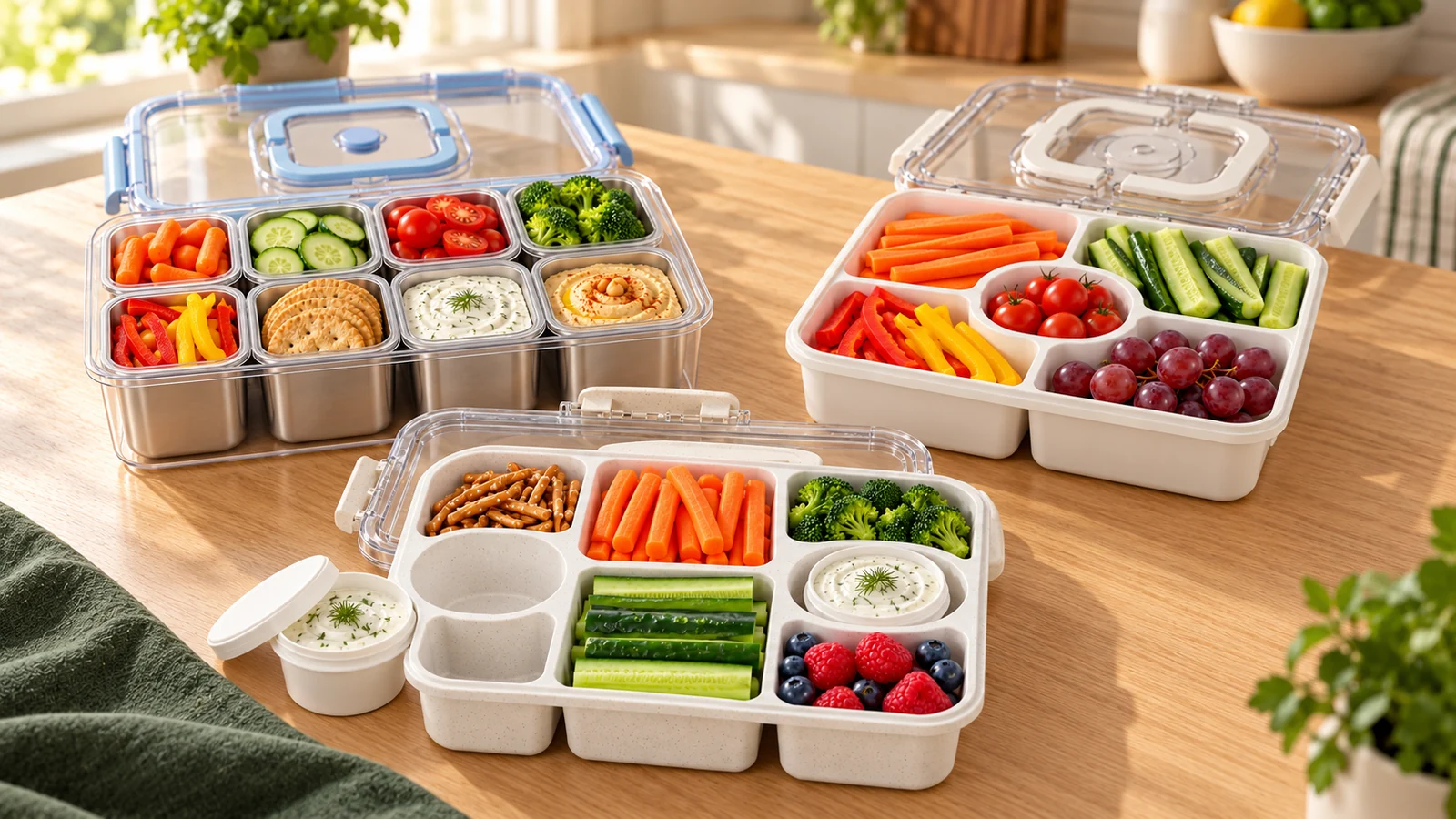
Three Snackle Box Containers to Compare
These options illustrate different ways to separate snacks and dip. We compared published product listings and specifications; we have not personally tested these containers or their leak resistance. Sealing, material and cleaning claims below come from the sellers.
| Container | Useful design feature | Main trade-off |
|---|---|---|
| Helecors | Individually lidded steel cups | More cups and lids to wash |
| Caperci White 2-pack | Five-section layout with a dip container | Two boxes to store |
| RicheMake | Eight sections and two sauce cups | More sections can limit space for long cuts |
Helecors: Removable Stainless Steel Cups with Individual Lids
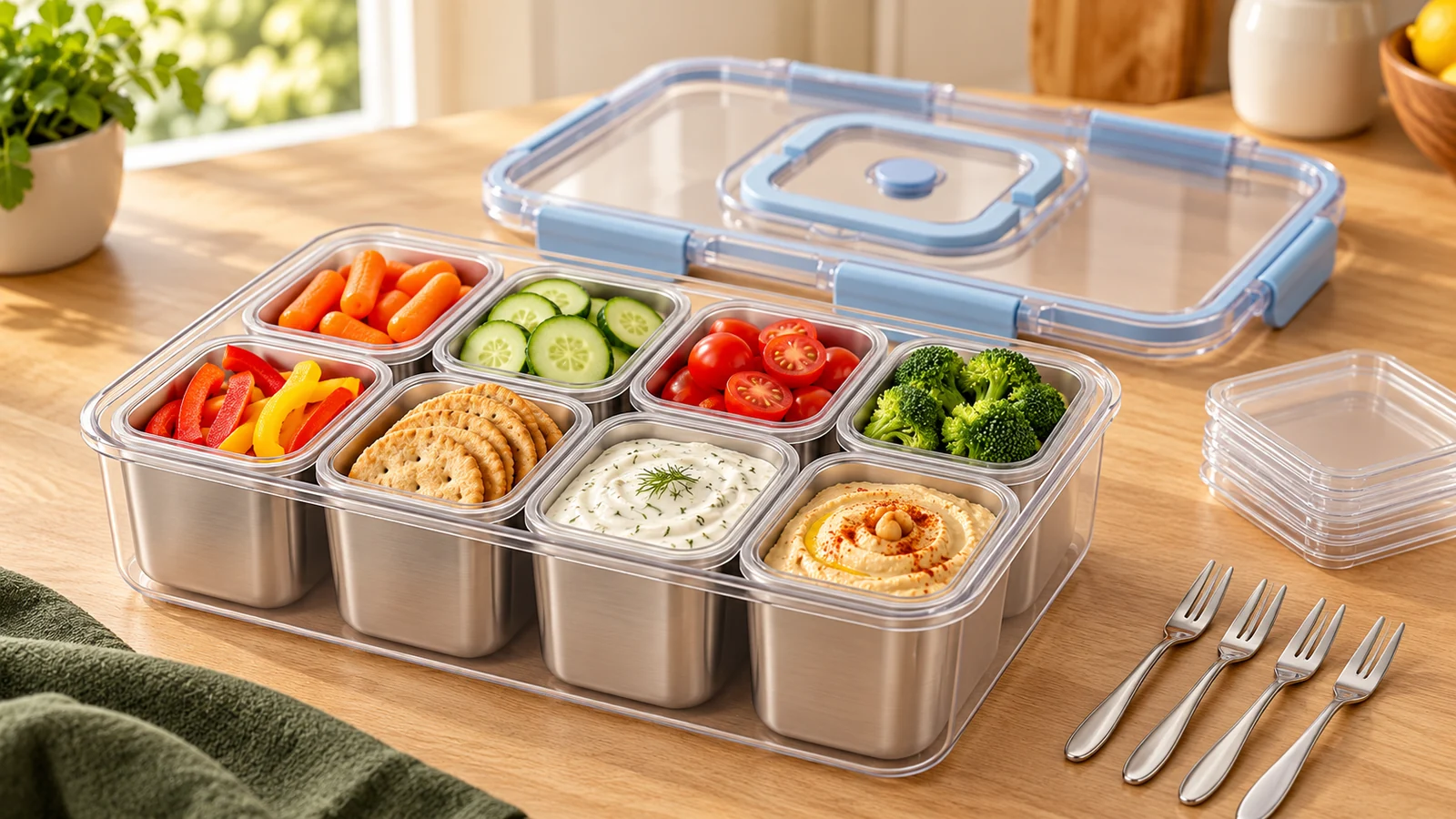
Consider this design if you prefer lifting out individual portions and covering them separately. The listing specifies eight removable 304 stainless steel cups with individual lids and four forks. The complete product also contains plastic and silicone; it is not an all-metal container.
Individual lids give you a separate closure for each cup, but they also add pieces to open, wash, dry and store. Before using a cup for thin dressing, confirm the instructions for liquids and close its lid as directed. We have not verified the seal in use.
The seller advertises dishwasher-safe cleaning. Check the supplied instructions for the cups, lids and outer carrier separately. The listing contains inconsistent dimension and capacity fields, so we are not quoting an overall size or capacity here. Confirm the closed-box measurements before buying it for a particular cooler.
Check the Helecors snackle box details on Amazon.
Caperci: Five Compartments with a Dedicated Dip Container
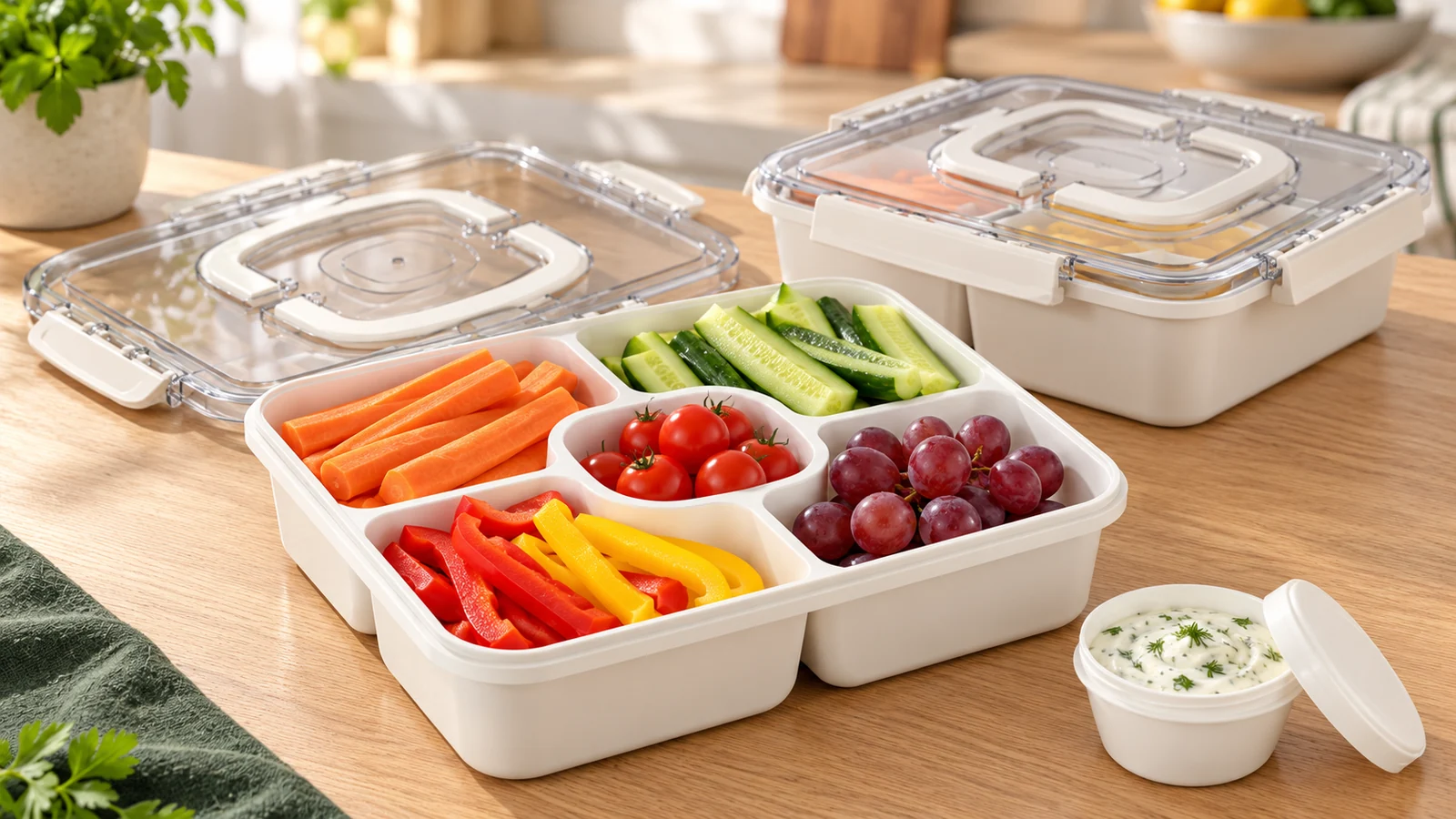
This option suits a packing layout built around four surrounding food sections and a round center section. The linked white variant is a two-pack: the listing includes two five-compartment boxes with lids and two dipping containers, each with a stated capacity of 5.2 ounces. Choose it when that layout fits your usual vegetables and snacks, rather than assuming you need eight sections.
The seller describes the dipping containers as leakproof; that is a product claim, not our test result. Follow the filling and closure instructions. For cleaning, the listing allows top-rack dishwasher cleaning but recommends hand washing the lid.
The main trade-off is the package size: you are buying and storing two boxes. If you need only one, compare the selected package carefully with a single-box alternative.
Check the Caperci white two-pack details on Amazon.
RicheMake: Eight Compartments with Two Sauce Cups
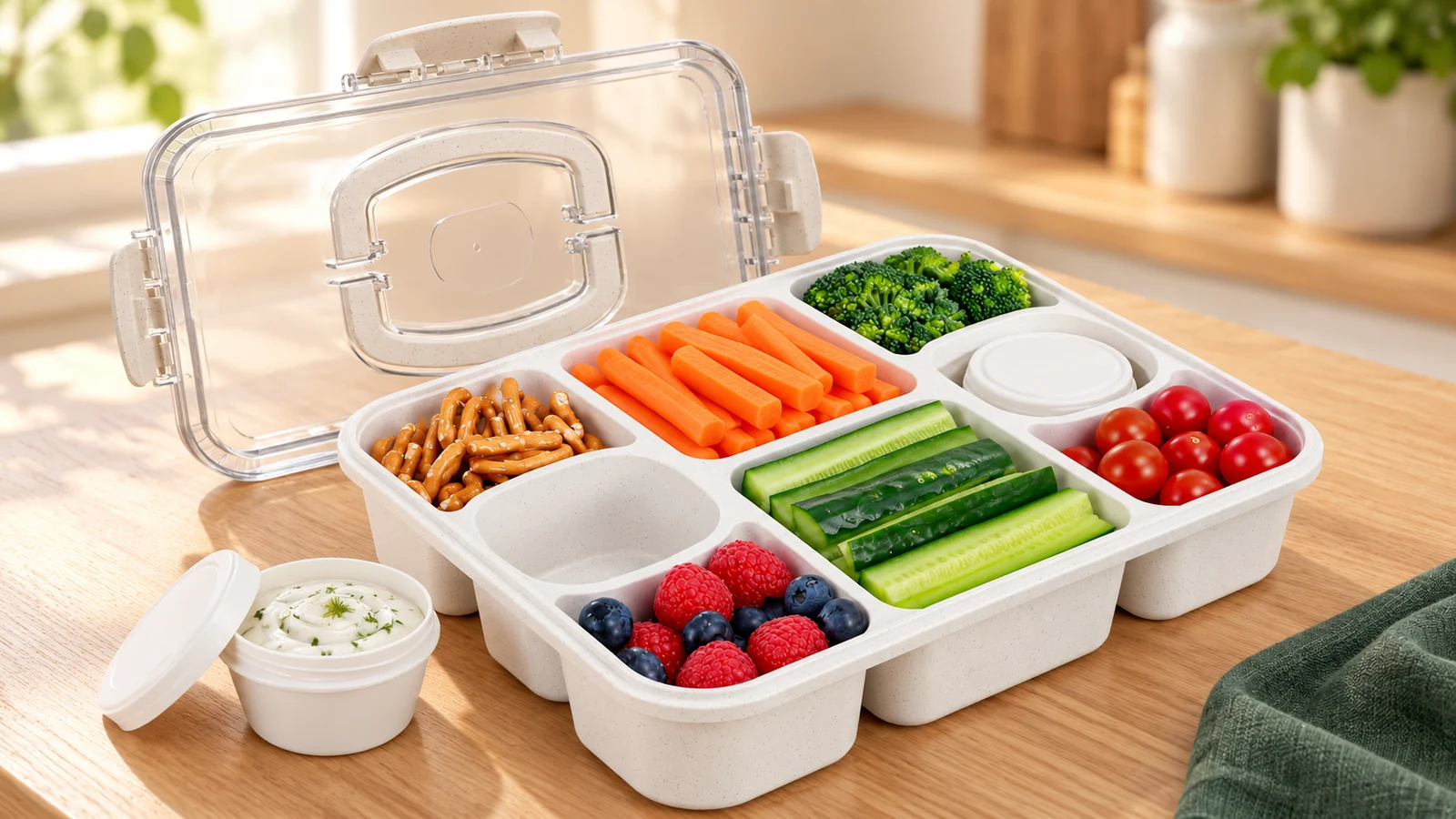
Consider RicheMake if you want a wider variety of snacks with two different dips. The linked white version is listed as an eight-compartment serving box with a lid, handle and two sauce cups. This gives it a different packing role from the five-section Caperci design.
The listing identifies wheat straw and ABS among its materials and advertises dishwasher-safe cleaning. Check the care instructions for each component. Having two sauce cups does not by itself establish that they seal individually or prevent liquid moving between sections; confirm those details before carrying thin sauces.
More sections are useful only if the food fits them. Check usable compartment space for cucumber spears or celery. The page also gives conflicting width measurements, so we are omitting precise external dimensions until they can be confirmed.
Check the RicheMake eight-compartment box details on Amazon.
Choose Helecors for individually covered steel cups, Caperci for its five-section layout and included dip container, or RicheMake for its two-sauce arrangement. None of these features replaces the need to check fit, handling and care instructions for the selected version.
What to Check First
| Feature | Question to ask | Why it matters |
|---|---|---|
| Intended use | Does the manufacturer identify the exact product as suitable for food storage? | A fishing or craft organizer is not automatically a food container |
| Internal layout | Will your vegetables and dip cup fit with the lid closed? | Outside dimensions do not describe usable compartment space |
| Liquid separation | Are the compartments individually sealed, or do they share one outer lid? | Dip or pickle liquid may cross a divider when the box tilts |
| Cleaning | Which components are dishwasher-safe, and can seals be removed? | The lid, base and inserts may need different care |
| Portability | Does it fit in the bag or cooler with cold packs? | The container itself does not provide refrigeration |
| Storage | Can it fit in your refrigerator and cabinet? | Handles and tall lids can increase the space it needs |
Choose the Layout Around What You Eat
Fixed Compartments
A fixed-divider box gives each food a defined space. It can suit a repeatable snack combination, such as two vegetables, crackers and a separate dip cup.
The limitation is flexibility. A compartment may be too short for celery or too narrow for the cup you already own. Check internal measurements where available, and avoid assuming that a food photo shows the quantity you will receive or the scale accurately.
Removable Cups or Trays
Removable inserts can make it easier to arrange different foods or lift out one portion. They also create additional pieces to wash and store.
An open removable cup is not the same as a sealed dip container. If you want to pack hummus or yogurt dip, check whether that cup has its own suitable lid and whether the manufacturer describes it as appropriate for liquids.
Adjustable Dividers
Adjustable dividers may help when your snack selection changes. Before choosing them, check how they attach and whether their gaps matter for the food you plan to pack.
Dividers that keep crackers apart do not necessarily contain thin dip. Use a separate closed food container for liquid or semi-liquid ingredients unless the manufacturer confirms that the relevant compartment seals appropriately.
Start with a combination you actually pack, such as carrot sticks, cucumber, crackers and a closed dip cup, then work backward to the space it needs. Our 10 snackle box ideas with vegetables and dips offer combinations to help you plan your layout.
A Single Outer Lid vs. Individual Lids
The lid is one of the most important details to examine in a snackle box container. A lid may close firmly around the outside while leaving space above the internal dividers.
That arrangement can keep solid foods organized on a level surface, but it does not establish that each section is isolated when carried. A handle or four clips also does not prove leak resistance.
Look for clear answers to these questions:
- Does the product claim to be leakproof, spill-resistant or simply lidded?
- Does that claim apply to the outer box, individual compartments or both?
- Are there restrictions on liquids, filling levels or carrying positions?
- Do the dip cups have separate lids?
If the listing does not answer, ask the seller or manufacturer before buying. For travel, a separate closed dip container is a practical option when compartment sealing is uncertain. Keep the box upright and follow its handling instructions.
How Big Should a Snackle Box Be?
There is no standard capacity that makes a container suitable for one person or a family. The food selection and length of the outing matter as much as the number of compartments.
A useful way to choose is to lay out one typical snack on a plate: vegetables, a filled dip cup and any extras. Measure the space occupied by the pieces, then compare that with the container’s internal layout.
| Intended use | Layout to consider | Check before ordering |
|---|---|---|
| A small snack for one | A compact box with space for vegetables and a dip cup | Whether the cup fits under the closed lid |
| Two people sharing | Several usable sections rather than many tiny ones | Room for serving utensils and separate wet foods |
| A longer outing | A box that fits your cooler or insulated bag | Space around it for the necessary cold sources |
| Serving at a picnic table | An easy-to-access layout | Whether you can keep reserve food chilled separately |
Do not treat a stated liquid capacity as a promise about how many chips or vegetable sticks fit. Tall cups, thick walls and removable inserts all affect usable space.
Check the Material and Care Instructions Together
Material names are a starting point, not a complete set of instructions. The base, clear lid, clips, seal and dip cups may use different materials and have different limits.
Before buying, look for instructions for the complete product:
- Is each part intended for food contact?
- Is it for cold storage only, or are other uses specifically permitted?
- Which parts, if any, may go in the dishwasher?
- Are there rack, temperature or detergent restrictions?
- Is microwave or freezer use explicitly allowed?
If a listing describes the same component as PET in one place and PP in another, resolve the discrepancy before relying on its care claims. Do not infer heating permissions from a plastic type or a photograph.
USDA’s guidance on food packaging materials explains why materials intended for cold storage should not automatically be used for heating.
Cleaning Details Worth Looking At
Inspect photos for corners, removable seals and the edges of the inserts. Think about whether you can reach them with the cleaning tools you normally use.
Follow the manufacturer’s directions for removing and replacing any gasket. Let cleaned components dry before storing them, and check that the seal is seated correctly before the next use.
A dishwasher-safe base does not establish that the lid is dishwasher-safe. If simple cleanup is a priority, choose a product with clear instructions for every component rather than relying on a general badge in a marketplace listing.
Will It Fit in Your Cooler?
Measure the cooler or insulated bag before ordering a large box. Allow room for the closed container, protruding clips or handles, and cold sources. A box that fits by itself may leave too little room for the rest of the packing arrangement.
Cut vegetables and prepared dips need cold storage. Keep perishable foods at 40°F (4°C) or below. For a packed snack or lunch bag containing perishables, USDA recommends at least two cold sources.
An ice compartment or included cold pack does not by itself prove that food will remain cold for a specified number of hours. Without temperature control, apply the two-hour limit for perishable foods, or one hour above 90°F (32°C).
Do You Need a Dedicated Snackle Box?
You may already have a suitable divided lunch container. Another option is to place a few small closed food containers inside an insulated bag.
A dedicated box is worth considering when its layout makes packing, carrying or serving easier for you. Compare the entire routine: filling it, finding refrigerator space, transporting it, washing it and storing the empty pieces.
For serving food at home, compare the open serving designs in our chip and dip bowl guide. Our creative veggie tray ideas also show ways to arrange vegetables without buying a specialized carrier.
Questions to Ask Before You Buy
- What are the external dimensions with the lid closed?
- What are the internal dimensions of the compartments I will use?
- Is this exact product intended for direct food contact?
- Can the dip compartment hold liquids, and does it have its own seal?
- What cleaning instructions apply to the base, lid, clips and inserts?
- Is the pictured package one box or a multi-piece set?
- Can I return it if its size or layout does not suit my needs?
Check the selected size and variant before paying. Marketplace photos sometimes show multiple sizes or stacked boxes even when the selected offer is for a single item.
Frequently Asked Questions
Is every snackle box food-safe?
No such assumption should be made from the name alone. Choose a product explicitly intended for food storage and follow its use restrictions. A photo containing fruit is not a substitute for clear product information.
Are individual lids necessary?
They are useful when you want to isolate dip or other wet ingredients. They may be unnecessary for a box used only to organize dry snacks. Check the documented sealing features rather than counting clips.
Can I use silicone cups as dividers?
Food-use silicone cups may help separate solid foods if they fit the box. An open liner does not create a sealed liquid compartment. Follow the cup manufacturer’s instructions as well as the box instructions.
Can I put a snackle box in the dishwasher?
Only when the instructions for that exact component allow it. Check the lid and inserts separately from the base, including any top-rack restrictions.
Is a snackle box the same as a bento box?
The terms overlap. Both can describe compartmented food containers, but the name does not guarantee a particular size, seal or temperature capability. Compare the specifications and layout instead.