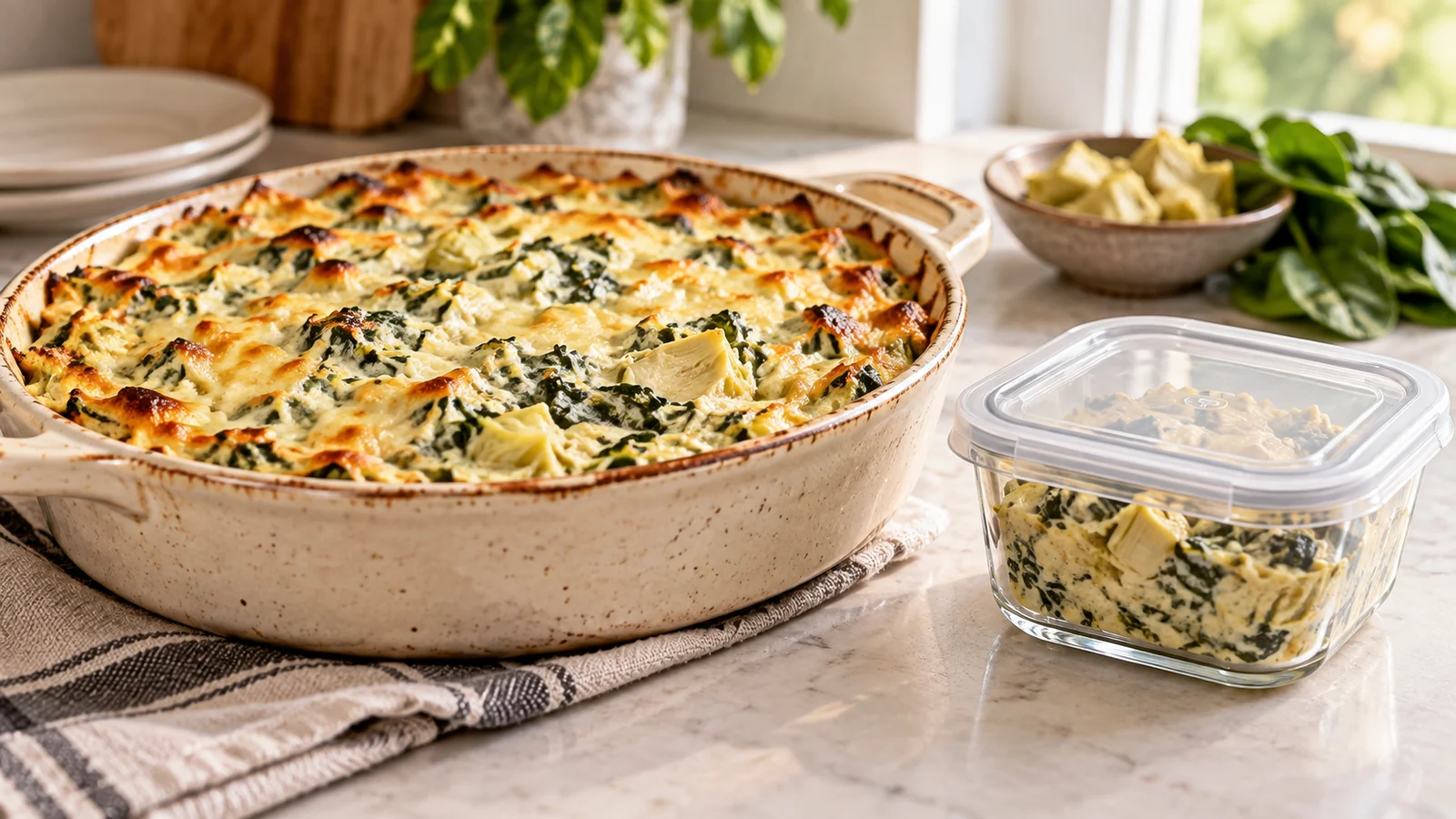
Can You Freeze Spinach Artichoke Dip? How to Keep It Creamy
Quick answer: Yes, you can freeze spinach artichoke dip if it has been stored safely. The main trade-off is texture: sour cream, mayonnaise, and some cheeses may separate after thawing. For other warm dip ideas, browse our hot vegetable dips. Freeze small portions promptly, thaw in the refrigerator, and stir as you reheat. A freshly made dip will still have the best texture.
There is a big difference between freezing a pan you prepared for next week’s gathering and freezing a bowl that has been sitting on the party table. Start with dip that is still within its safe storage window. Freezing pauses deterioration; it cannot make improperly stored dip safe again.
Does spinach artichoke dip freeze well?
It can, especially when you plan to serve it warm. Expect a little extra liquid or a less silky texture after reheating. Spinach and artichokes hold moisture, while dairy-rich bases can become grainy or split. That is a quality issue, not automatically a sign that the dip has spoiled.
| Dip base | What you may notice after thawing | Best approach |
|---|---|---|
| Cream cheese and shredded cheese | Usually reheats into a spoonable dip, though it may need stirring | Reheat gently and stir thoroughly |
| Sour cream or Greek yogurt | More likely to release liquid or look grainy | Freeze a small test portion if appearance matters |
| Mayonnaise-heavy dip | May separate into oily and watery layers | Make fresh for the smoothest result |
These are practical texture expectations, not guarantees; recipes vary. The USDA notes that mayonnaise and cream sauces can lose quality in the freezer. USDA freezing guidance
How Long Does Spinach Artichoke Dip Last in the Fridge?
As a conservative starting point, cooked spinach artichoke dip that was refrigerated promptly can generally be handled using the USDA/FoodSafety.gov leftovers framework: keep it at 40°F (4°C) or below and use refrigerated leftovers within about 3–4 days. This is general leftovers guidance rather than a tested shelf life for every spinach dip recipe.
For store-bought spinach or spinach artichoke dip, follow the package or manufacturer storage instructions when they differ. If you need broader guidance on refrigeration, room-temperature limits and freezing, see How Long Does Veggie Dip Last?.
Can you freeze spinach artichoke dip before baking?
Yes. If your recipe calls for mixing the dip and baking it just before serving, assemble it in a freezer-safe container, cover tightly, and freeze it before the final bake. If the recipe includes a crisp cheese or breadcrumb topping, add that topping just before baking for a better finish. Thaw the dip in the refrigerator and bake according to the recipe, allowing extra time if it is still cold in the center. Follow your recipe’s cooking instructions for a newly assembled dish.
Already baked it? Freeze the leftovers in individual portions. Small containers cool and thaw more evenly, and you can reheat only what you need. Do not put a glass or ceramic dish directly from the freezer into a hot oven unless its manufacturer explicitly says that is safe.
How to freeze spinach artichoke dip
- Check how long it sat out. Refrigerate or freeze perishable dip within two hours of serving, or within one hour if the temperature is above 90°F (32°C). Discard it if it exceeded that limit.
- Cool it promptly. Divide warm dip among shallow containers and refrigerate or freeze promptly. Do not leave a large pan on the counter to cool completely.
- Portion and seal. Transfer to airtight, freezer-safe containers with a little room for expansion, or use freezer bags laid flat. Keep the portion sizes useful for a single meal.
- Label it. Write the name and freezing date. Keep the freezer at 0°F (-18°C) or below.
If the dip has already been refrigerated, use or freeze cooked leftovers within four days. For the most appealing texture, aim to use this particular dip within one to two months; that is a quality suggestion, not a food-safety expiration date. FoodSafety.gov gives a broader two-to-six-month best-quality range for frozen leftovers in general, while noting that continuously frozen food can remain safe longer as quality declines. FoodSafety.gov leftovers guidance
How to thaw and reheat frozen spinach artichoke dip
Move the sealed container to the refrigerator until thawed. A small portion may thaw overnight; a deep container will take longer. Do not thaw it on the counter. If you need the dip sooner, you can reheat a frozen portion directly, but it will take longer and should be stirred for even heating.
Oven: Transfer the thawed dip to an oven-safe dish. Cover and warm at about 350°F (175°C), stirring partway through if practical. Uncover near the end if you want a browned top. Oven time depends on the depth and starting temperature; check the center with a food thermometer.
Microwave: Cover loosely and heat in short intervals, stirring between them. Let it stand briefly, stir again, and check several spots because microwaves can leave cold pockets.
For previously cooked leftovers, reheat to 165°F (74°C) throughout. For a store-bought frozen dip, follow the package’s cooking and storage directions first. FoodSafety.gov leftovers guidance
If the reheated dip is watery or grainy
Stir the dip while it is warm. If liquid pools on top, gently stir it back in; if there is a lot of free liquid, spoon off a little before serving. A small amount of freshly shredded cheese or cream cheese can help bring back body, but heat slowly and avoid boiling it hard. A broken emulsion may improve without returning exactly to its original smoothness. For more general fixes, see how to fix a watery dip.
When should you throw it out instead?
Discard spinach artichoke dip that exceeded the two-hour room-temperature limit (one hour above 90°F), even if you intend to freeze or reheat it. Also discard it if you cannot establish how long it was unrefrigerated. Do not rely on smell or appearance alone to judge safety. Prompt chilling in shallow containers and reheating cooked leftovers to 165°F are the key safeguards. FoodSafety.gov food safety steps
Frequently asked questions
Can you freeze store-bought spinach artichoke dip?
Check the label for freezing and reheating directions. For a refrigerated, ready-made dip, freeze it while it is still within the manufacturer’s use instructions; the packaging may not be freezer-safe, so transfer it to a suitable container if necessary. Expect some separation after thawing. Never freeze it as a way to rescue dip left out too long.
Can you freeze spinach artichoke dip made with sour cream?
Yes, but sour cream often looks less smooth after thawing. Freeze a small portion first if you are making it for guests. Stir gently while reheating and serve it warm, where a slight texture change is less noticeable.
How long can you keep it in the refrigerator before freezing?
Freeze cooked leftovers within four days of making or serving them, provided they were refrigerated promptly. Earlier is better for quality. For broader dip storage advice, see how long veggie dip lasts.
Should you freeze it in the baking dish?
Only if the dish is explicitly freezer-safe and you can cover it tightly. Portion-sized freezer containers are easier to thaw and reheat. Follow the dish manufacturer’s guidance before moving any chilled dish into a hot oven.