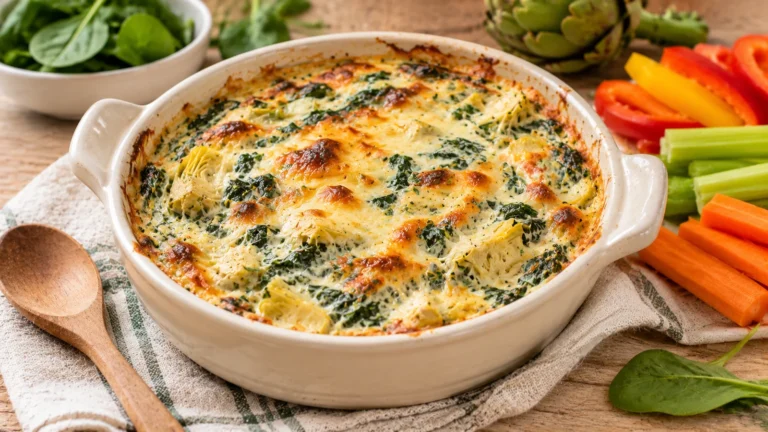
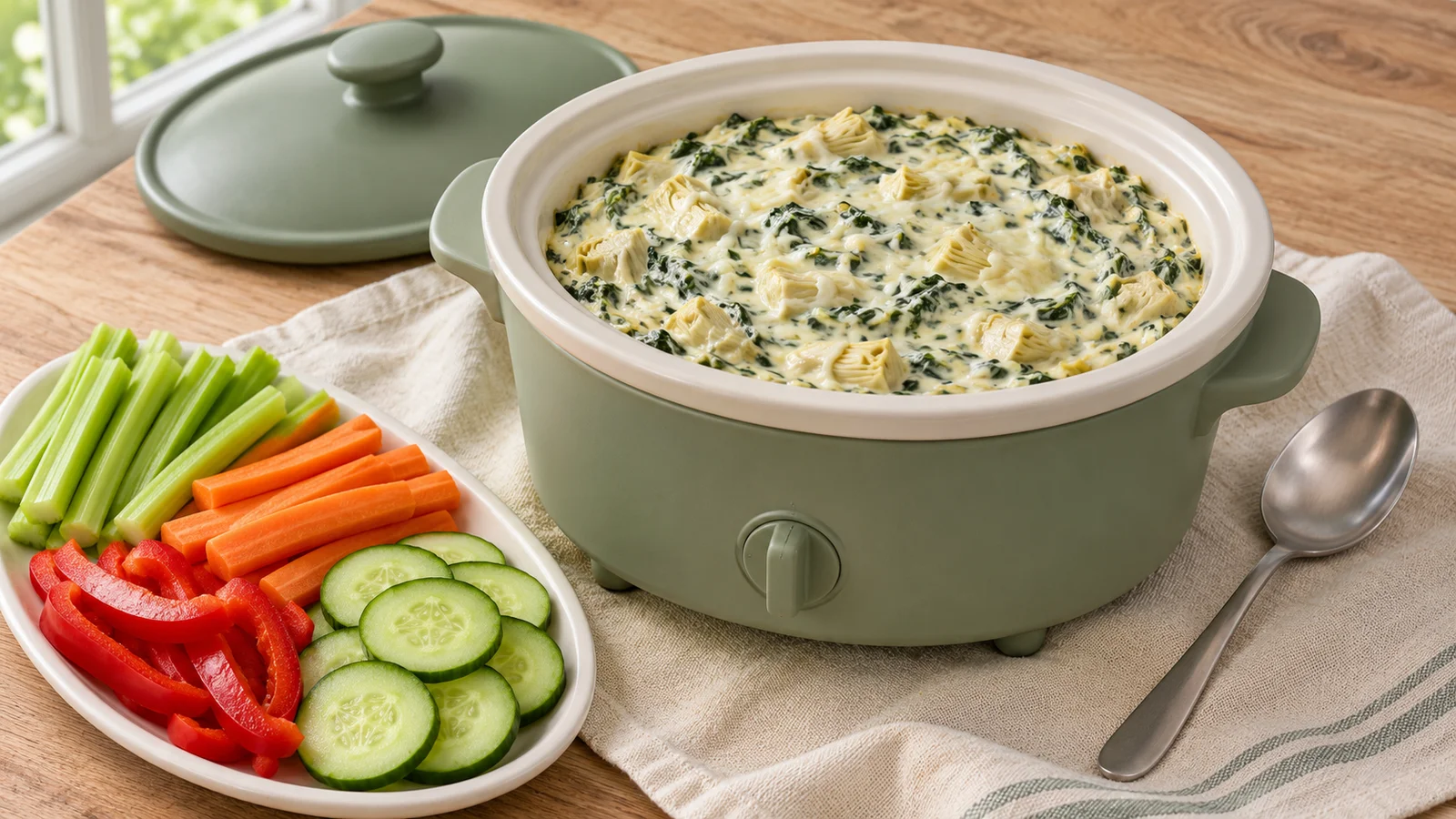
Slow cooker spinach artichoke dip combines chopped spinach, artichoke hearts and melted cheese in a warm, scoopable appetizer. A small slow cooker leaves the oven available for other dishes and can hold the finished dip hot when its temperature is checked. If you prefer an oven-baked version without artichokes, try our Hot Spinach Dip Recipe. For an oven-baked option with artichokes and fresh spinach, see Fresh Spinach Artichoke Dip.
Quick answer: Thaw and thoroughly squeeze the spinach, drain and chop the artichokes, then combine them with cream cheese, sour cream, mozzarella, Parmesan and garlic. Cook on LOW for approximately 2–3 hours, stirring briefly partway through, until the dip is evenly hot and the cheese has melted. Appliance size and heating performance affect the time.
This is a research-based recipe adaptation, not a kitchen-tested Vegetable Dips recipe. The timing and yield are planning estimates. Follow your slow cooker’s instructions, check the dip as it heats and use a thermometer rather than treating a timer as proof of readiness.
Ingredients and Texture Notes
Frozen chopped spinach: Use a 10-ounce (283 g) package, measured before thawing. Thaw it in the refrigerator and squeeze out the liquid in a clean food-safe cloth or fine-mesh strainer. Break apart the compressed spinach before mixing so it distributes through the cheese.
Artichoke hearts: Choose a 14-ounce (397 g) can packed in water, then drain and chop. The can size is the packaged weight, not the final drained weight. Marinated artichokes bring oil, acidity and seasoning, so they are not an identical substitution.
The cheese base: Plain block cream cheese gives body, sour cream loosens the mixture and mozzarella adds melt. Finely grated Parmesan adds saltiness. Start with pepper and taste before adding salt; cheese brands differ.
Choose a Suitable Slow Cooker
Plan around a small slow cooker, approximately 3 quarts, and check its manufacturer’s fill guidance. This batch is not intended to cover the bottom of every large cooker. A shallow layer in an oversized insert can heat and dry around the edges differently from a deeper mixture in a smaller pot.
Do not automatically double the recipe to fill a large cooker without allowing for different heating time and stirring. Check that the insert and lid are suitable for the intended use; do not move a refrigerator-cold ceramic insert directly into a heated base unless the manufacturer permits it.
Slow Cooker Spinach Artichoke Dip
Ingredients
Method
- Thaw spinach in the refrigerator according to its package. Squeeze thoroughly, then loosen the compressed leaves. Drain and chop the artichoke hearts. Thawing time is additional to the active preparation estimate.
- Use a suitable small slow cooker, approximately 3 quarts, following its fill instructions. Combine spinach, artichokes, sour cream, mozzarella, Parmesan, garlic and pepper in the insert. Distribute small cream cheese cubes through the mixture. Do not add water.
- Cover and cook on LOW for approximately 2–3 hours. Stir briefly after about an hour, then check periodically without leaving the lid off unnecessarily. Cooker performance varies; the 3-hour cook time shown is a planning allowance.
- Stir thoroughly so the melted cheese blends evenly. Check several places with a food thermometer and heat the casserole-like dip to 165°F (74°C) before serving. If it is not evenly hot, continue cooking and checking. Taste before adding salt.
- Serve with sturdy vegetable pieces and a spoon. Use WARM only after cooking and only if the food remains at or above 140°F (60°C), verified with a thermometer. Stir occasionally and avoid prolonged cooking that dries the edges.
- Transfer leftovers to shallow covered containers and refrigerate promptly. Do not use the slow cooker to reheat refrigerated leftovers; reheat by microwave, stovetop or oven to 165°F (74°C) throughout.
Notes
How to Keep the Dip Thick Enough for Vegetables
Control the water before cooking. Spinach and artichokes both contribute moisture, while cheese can release fat when overheated. Extra cooking is not a reliable fix for a mixture that started with poorly drained ingredients.
After the cheese melts, stir from the sides toward the middle. Check the whole pot, not only a bubbling edge. If it is already thick, stop cooking once it is thoroughly heated; keeping it on HIGH to create an oven-style crust can scorch the edges.
| Problem | What to check | Practical adjustment |
|---|---|---|
| Watery dip | Spinach drainage, artichoke liquid and lid condensation | Stir first. If still loose, briefly cook uncovered on LOW while monitoring; stop before the edges dry out. |
| Cream cheese lumps | Large cold pieces that have not melted | Use small cubes at the start and stir once they soften. Avoid beating a cold block into hot dip. |
| Oily or separated texture | Overheating or prolonged holding | Reduce heat, stir gently and serve promptly while maintaining safe holding temperature. |
| Dry edges | Oversized cooker, high heat or too little mixture | Stir early enough to catch the problem; do not scrape scorched bits into the whole batch. |
For other thickening methods, see how to fix a watery dip. The right adjustment depends on whether you are dealing with water, melted fat or an underheated cheese base.
What to Serve with Slow Cooker Spinach Artichoke Dip
Celery sticks, sturdy bell pepper strips and carrot sticks offer firm scoops. Thick cucumber rounds are easier to spread with a little dip than to push through the entire mixture. Cut vegetables into manageable pieces and keep their serving tray away from hot appliance surfaces and cords.
Put out a spoon so guests can transfer dip to a plate. Crackers or toasted bread can be offered separately, but they are optional. Use our vegetable pairing guide for more choices, and the game-day dip guide if you want a second, contrasting bowl.
Make-Ahead, Holding and Leftovers
You can thaw and drain the spinach, chop the artichokes and measure the cheeses the day before. Store the prepared ingredients covered in the refrigerator and keep the cheese cold until preparation. This lets you start with a room-temperature appliance insert rather than relying on a refrigerated ceramic pot.
Once the dip is fully cooked, use a suitable holding setting only if it maintains the food at 140°F (60°C) or above. Check with a thermometer and follow the appliance instructions. WARM is for holding hot food, not starting the cooking process; a setting name does not guarantee a particular food temperature. See the USDA’s slow-cooker setting guidance.
Transfer leftovers into shallow covered containers and refrigerate promptly rather than cooling the whole crock on the counter. Keep perishable food out of temperature control for no more than two hours, or one hour above 90°F (32°C). Follow our dip storage guide for further storage planning.
Reheat refrigerated leftovers in the microwave, on the stovetop or in a suitable oven-safe dish until they reach 165°F (74°C) throughout. The USDA does not recommend reheating leftovers in a slow cooker. After reheating, a preheated slow cooker may hold the hot food at or above 140°F (60°C).
Thinking about freezing a portion? Our spinach artichoke dip freezing guide covers texture changes, thawing and reheating. Dairy-based dips can change consistency after freezing, so freezing is not a promise of the same texture.
Frequently Asked Questions
Is crockpot spinach artichoke dip the same thing?
“Crockpot” is commonly used in searches for slow-cooker recipes. This recipe is written for a suitable small slow cooker rather than requiring a particular brand. Follow the instructions for your exact appliance.
Can I use fresh spinach?
Fresh spinach is used in other established versions, but it has different volume and moisture behavior. This recipe specifies thawed, squeezed frozen spinach. For fresh spinach, follow a recipe developed around it rather than swapping equal cup measures.
Can I cook it on HIGH instead?
Comparable recipes use HIGH for roughly 1–2 hours, depending on the appliance and ingredients. Treat that as a reference range, not a guaranteed conversion for your cooker. Stir and check early, and stop only when the mixture is evenly heated, melted and ready to serve.
Does it contain mayonnaise?
No. This version uses sour cream and cheeses. It contains dairy, and Parmesan may use animal rennet; choose suitable cheeses if you need a vegetarian version.
Can I replace sour cream with Greek yogurt?
Some established recipes offer that option, but the texture and heat tolerance vary with the yogurt. The quantities here are specified for sour cream. Do not assume a low-fat substitution will produce the same result.
Recipe Research
This adaptation draws on the small-cooker approach in Gimme Some Oven’s recipe, the frozen-spinach drainage option and appliance-size guidance from Land O’Lakes, and the heat-setting examples in Crock-Pot’s recipe. The referenced preparations differ; our timing is an estimate, not a claim that this exact adaptation has been tested.